Physical Address
304 North Cardinal St.
Dorchester Center, MA 02124

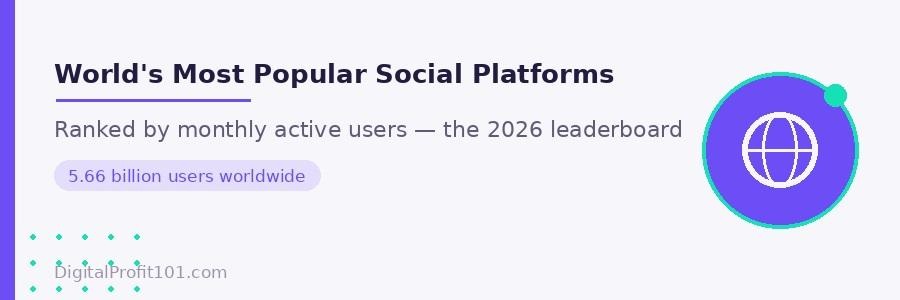
In 2026, the biggest social platforms each rival entire continents in scale
Social media in 2026 is bigger than ever — and more concentrated than most people realise.
There are now 5.66 billion social media user identities worldwide, representing roughly 68% of the entire global population. Seven platforms have crossed the one-billion-user mark, and a handful of companies — led by Meta — control most of the world’s online attention.
But which platforms actually lead? Who is growing, who is fading, and what does it all mean for creators, businesses, and anyone trying to build an audience online? This is the definitive 2026 ranking of the world’s most popular social media platforms, based on monthly active users (MAU), with the key takeaways you need to know.
5.66 Billion — Social media users worldwide in 2026 (about 68% of the global population)
7 Platforms — Now have over 1 billion monthly active users each
~2 Hours — Average time the typical user spends on social media every day
Before the rankings, one important point: ‘most popular’ depends on how you count. Most rankings use monthly active users (MAU) — the number of unique people who use a platform at least once a month. This is the standard measure of scale, and it is what we use here.
However, other metrics tell different stories. By advertising reach, the picture shifts. By total time spent, some analysts argue YouTube actually leads, with app-intelligence data suggesting it commands more total attention than any other platform. And by daily engagement, TikTok is the runaway winner. We will note these nuances where they matter — because for creators and businesses, where attention actually goes matters as much as raw user counts.
📊 Why the numbers vary slightly: Different sources report slightly different figures because some count monthly active users while others use advertising reach or app-based estimates. The figures here reflect the most widely cited 2026 data from sources like Salesforce, DataReportal, and Statista, rounded for clarity.
| Rank | Platform | Owner | Monthly Active Users | Primary Use |
| 1 | Meta | 3.1 billion | Social networking | |
| 2 | Meta | ~3.0 billion | Visual / photo & video | |
| 3 | Meta | ~3.0 billion | Messaging | |
| 4 | YouTube | 2.7 billion | Video | |
| 5 | TikTok | ByteDance | ~2.0 billion | Short-form video |
| 6 | Tencent | 1.3 billion | Messaging / super-app | |
| 7 | Messenger | Meta | 1.0 billion | Messaging |
| 8 | Douyin | ByteDance | 750 million | Short-form video (China) |
| 9 | Telegram | Telegram | 950 million | Messaging |
| 10 | Snapchat | Snap Inc. | 800 million | Messaging / AR |
| 11 | X (Twitter) | xAI / X Corp | 650 million | Microblogging / news |
| 12 | Reddit Inc. | 500 million | Forums / communities | |
| 13 | Pinterest Inc | 550 million | Visual discovery | |
| 14 | Microsoft | 1.0 billion | Professional networking | |
| 15 | Threads | Meta | 400 million | Text / microblogging |
Now let us look at the platforms that define the top of the leaderboard — and what makes each one matter.
Facebook’s 3.1 billion users represent roughly 40% of all humanity
Despite years of predictions about its decline, Facebook remains the undisputed king of social media by monthly active users. With more than 3.1 billion people logging in each month — roughly 40% of the entire global population — it is less a social network and more a piece of global infrastructure.
Facebook’s strength lies in its breadth. It serves every age group and demographic, and its ecosystem of features — News Feed, Groups, Pages, Marketplace, and integrated messaging — keeps it deeply woven into daily life worldwide. For businesses, Facebook remains one of the most powerful advertising and community-building platforms available, particularly for reaching audiences aged 30 and above.
Best for: Community building, local business marketing, Groups, Marketplace selling, and broad-reach advertising
Instagram and WhatsApp each reach around 3 billion users — both owned by Meta
Tied closely behind Facebook are two more Meta-owned giants, each with around 3 billion monthly active users.
Instagram has become the world’s premier visual platform, especially dominant among young adults, millennials, and creators. Its mix of feed posts, Stories, and Reels makes it the go-to platform for visual storytelling, brand building, and influencer marketing. For anyone selling products or building a personal brand, Instagram is often the single most valuable platform to master.
WhatsApp is the world’s most widely used messaging app, and in many countries — Brazil, India, Nigeria, and across Africa and Latin America — it is the primary way people communicate. Its end-to-end encryption, group features, voice and video calls, and business tools make it essential not just for personal chat but for small business sales and customer service.
Best for: Instagram — visual brands, creators, eCommerce; WhatsApp — direct sales, customer service, community in emerging markets
YouTube reaches 2.7 billion users — and may command more total attention than any platform
YouTube holds the fourth spot with about 2.7 billion monthly active users — but by some measures, it is arguably the most-used platform of all. App-intelligence data suggests YouTube commands more total time spent than any other social platform, making it the true heavyweight of online attention.
From short clips to long-form documentaries, tutorials, music, and live streams, YouTube is the definitive home of video content. For creators, it offers the strongest direct monetisation of any platform — ad revenue, channel memberships, and Super Chats — making it the platform where content creation most reliably becomes a real income.
Best for: Long-form video, tutorials and education, building authority, and direct creator monetisation
TikTok users spend an average of 95 minutes per day — more than on any other app
TikTok has grown explosively to around 2 billion monthly active users, ranking fifth globally — but in engagement, it stands alone. Users spend an average of 1 hour 35 minutes per day on TikTok, more than on any other social platform. That is not a quick visit; that is your audience settling in.
TikTok has also reshaped how people discover everything from products to information. Even Google’s own leadership has acknowledged that many young users now start their searches on TikTok or Instagram rather than a search engine. Its largest audience segment is 25–34 year-olds, followed closely by 18–24 year-olds. For creators and brands chasing reach and virality, TikTok still sets the pace.
Best for: Viral reach, short-form video, product discovery, and reaching Gen Z and younger millennials
Messaging apps quietly command billions of users and shape daily communication worldwide
Beyond the visual and video platforms, messaging apps form a massive and often underappreciated layer of the social media world.
WeChat is far more than a messaging app — in China, it is a complete ‘super-app’ for messaging, payments, shopping, government services, and more. If your audience includes the Chinese market, WeChat is indispensable; otherwise, it remains largely regional.
Meta’s Messenger, integrated with Facebook, remains one of the world’s most-used messaging platforms — increasingly important for business customer service and automated chat marketing.
Telegram (around 950 million users) has grown rapidly thanks to its focus on privacy, large group channels, and creator broadcasting. Snapchat (around 800 million) remains hugely popular with younger users and continues to pioneer augmented reality features.
Best for: Direct communication, community channels, customer service, and privacy-focused audiences
Behind the numbers, four major trends are reshaping the social media landscape
Meta owns four of the top nine platforms — Facebook, WhatsApp, Instagram, and Messenger — collectively reaching well over 8 billion user accounts. This concentration shapes the entire social media advertising ecosystem and gives one company unprecedented influence over global communication.
YouTube and TikTok dominate where attention actually goes. Short-form video in particular has become the defining content format of the era, and every major platform — from Instagram Reels to YouTube Shorts — has reoriented around it. For creators, video is no longer optional.
Three of the top seven platforms are messaging apps. WhatsApp, Messenger, and WeChat collectively reach billions, and increasingly, business is being conducted directly inside these private channels — especially in Africa, Asia, and Latin America.
The continued expansion of social media is being driven primarily by mobile-first users in Asia, Africa, and Latin America. For creators and businesses in these regions — including Nigeria and across Africa — this represents an enormous and still-growing opportunity to build audiences and reach buyers.
The real question is not which platform is biggest — but which one is right for your goals
Knowing the rankings is interesting. Knowing what to do with them is profitable. Here are the key takeaways you can act on right now.
1. Go where your audience already is — Do not try to be everywhere. Identify the one or two platforms where your specific target audience spends the most time, and focus your energy there before expanding.
2. Prioritise video — With YouTube and TikTok leading attention, video — especially short-form — is the single highest-leverage content format in 2026. Even a smartphone is enough to start.
3. Do not ignore messaging apps — WhatsApp and Messenger are among the highest-converting channels for direct sales and customer relationships, especially in Africa and emerging markets.
4. Build on platforms, but own your audience — Algorithms change and platforms rise and fall. Use social media to grow your reach, but convert followers into an email list or community you control.
5. Match the platform to the goal — Instagram for visual branding, YouTube for authority and monetisation, TikTok for reach, WhatsApp for sales, LinkedIn for B2B. Each platform has a job — use the right tool for yours.
Whichever platforms you choose, the real opportunity lies in turning that audience into income. That is exactly what we help you do at DigitalProfit101.com — with free, practical guides on content creation, affiliate marketing, selling digital products, and building an audience that actually pays.
🚀 Ready to Turn These Platforms Into Income?
DigitalProfit101 is your home base for turning social media knowledge into real online income — with free, beginner-friendly guides on content creation, affiliate marketing, digital products, and growing an audience that pays.
👉 Explore free guides and resources: https://digitalprofit101.com
By monthly active users, Facebook remains the largest with around 3.1 billion users. However, by total time spent and attention, YouTube is arguably the most-used platform, and TikTok leads in daily engagement. The ‘biggest’ depends on which metric you use.
There are approximately 5.66 billion social media user identities worldwide in 2026 — about 68% of the global population. The average person uses 7 to 8 different social networks and spends roughly 2 hours per day on social media.
YouTube offers the strongest direct monetisation through ad revenue and memberships. TikTok and Instagram excel at building large audiences quickly. WhatsApp is the highest-converting channel for direct sales, especially in Africa. The best choice depends on your content type and audience.
TikTok continues to grow rapidly in both users and engagement, while Threads, Telegram, and Reddit have all seen strong growth. Overall growth is being driven primarily by mobile-first users in Asia, Africa, and Latin America.
Visit DigitalProfit101.com for free, beginner-friendly guides on content creation, affiliate marketing, selling digital products, and turning your social media presence into a real online income.
Published on DigitalProfit101.com | Category: Social Media & Marketing