Physical Address
304 North Cardinal St.
Dorchester Center, MA 02124

How I Made My First $1,000 Selling a PDF – And How You Can Too. One PDF. One clear strategy. $1,000 in 47 days – without a single paid ad
I want to tell you something that nobody told me when I started trying to make money online.
You do not need a huge following. You do not need a polished website. You do not need paid advertising, a professional camera, or years of experience. You need one thing: a PDF that solves a real problem for a specific person – and the courage to put it up for sale.
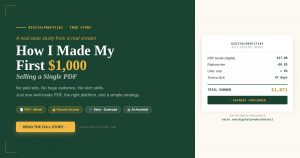
This is the true story of how I made my first $1,000 online by selling a single PDF guide. Not a course. Not a membership. Not a complicated funnel. A PDF. Priced at $17. Sold to 63 people over 47 days, almost entirely through WhatsApp and Instagram, with zero advertising budget.
I am going to walk you through every step – the idea, the creation, the pricing, the launch, and the moment that first sale notification arrived. More importantly, I am going to show you the exact system so you can replicate it.
$17.00 – PDF price
$0.85 (approx 5%) – Platform fee
63 copies – Units sold
47 days – Days to $1,000
$1,071 — Total earned
And at the end of this guide, you will find a link to the complete blueprint – Digital Products That Sell – which goes even deeper on every step covered here.
The right topic is not what you find interesting — it is what your audience is desperate to learn
Here is a mistake almost every first-time digital product creator makes: they pick a topic they find interesting instead of a topic their audience is desperate to learn.
The PDF that eventually made me $1,000 was not my most passionate idea. It was not my most creative idea. It was the idea that answered a question I kept seeing repeated in the communities I was part of – a question I already knew how to answer, that other people were willing to pay to have answered clearly and completely.
I spent one week doing nothing except observing. I looked at:
The pattern that emerged was clear. People in my audience kept asking the same core question, phrased different ways. That question became my PDF.
The most important thing I learned is this: people do not buy ‘a PDF.’ They buy a specific outcome. They pay for a faster result, a clearer path, fewer mistakes, or a saved week of trial and error.
The title of your PDF is everything. Compare these two:
I wrote the second type. And that specificity was 80% of what made it sell.
💡 Validate before you create. Before writing a single word, ask three to five people in your target audience if they would pay your intended price for a guide on your topic. If two of them say yes immediately, you have validated your idea. If they hesitate or say ‘maybe,’ refine the topic or the promise until the yes comes easily.
A professional, sellable PDF can be created with free tools in 48 hours
Once the topic was locked in, I gave myself one rule: the PDF had to be finished and listed for sale by Sunday night of that same weekend. No perfectionism. No ‘I’ll finish it next week.’ Done is the only version that earns money.
My PDF was 34 pages long. Not 100 pages. Not 200 pages. Thirty-four focused, practical pages that delivered on the exact promise in the title. Each chapter answered one specific question. There was no filler, no padding, no theoretical waffle. Just: here is the problem, here is the solution, here is how to implement it.
📄 Length does not equal value: A focused 25-page PDF that solves one problem completely will always outsell a vague 150-page document that covers everything loosely. Buyers want outcomes, not volume. Keep your PDF tight, practical, and outcome-focused.
For the complete PDF creation walkthrough with prompts and templates, get the Digital Products That Sell guide at https://selar.com/digitalproducthatsell.
Price too low and you signal low value. Price with confidence and watch conversions improve
I almost priced my PDF at ₦2,500 (about $2). That would have been a mistake.
My instinct was to make it as accessible as possible – to remove every barrier to purchase. But I had it backwards. Low prices do not remove barriers; they create new ones. When something is priced too cheaply, buyers wonder why. They assume the content is basic, the information is available free somewhere, or the creator does not believe in their own product.
I researched what comparable PDFs were selling for on Selar and Gumroad. Similar guides in my niche were priced between $12 and $30. I chose $17 – close enough to the middle to feel accessible, premium enough to signal real value.
The result surprised me. Buyers did not push back on the price at all. In fact, I got more serious inquiries after I raised it from an initial $12 test price to $17. The higher price attracted buyers who were genuinely committed to using the guide, and those buyers left better reviews.
💡 The ‘too cheap’ trap If you are wondering why your PDF is not selling at ₦500 or ₦1,000, consider raising the price. Many creators have doubled their revenue simply by doubling their price – because the higher price attracted buyers who were more serious, more committed, and more likely to leave positive reviews.
Every sale in the first 47 days came from organic promotion — not a single paid ad
My entire marketing budget for this launch was zero Naira. No Facebook ads. No Google ads. No influencer paid partnerships. Just consistent, authentic promotion through channels I already had access to.
Here is exactly what I did, in the order I did it.
The first thing I did on launch day was update my WhatsApp status with a simple message: a mockup of the PDF cover, the title, the price, and the link to my Selar page. I also sent a personal message to 20 people I knew had expressed interest in the topic.
By the end of day one, I had five sales. Five people I already knew, who already trusted me, paid $17 each because I had created something they genuinely wanted. That was $85 in the first 24 hours – enough to confirm the product was viable.
I created a simple three-slide Instagram carousel: slide one was the problem my PDF solved, slide two was a preview of the chapter list, slide three was the price and a link to buy. No fancy graphics – just clear, benefit-led text on a clean background made in Canva.
I posted this carousel and then spent 30 minutes each day for the next week engaging in comments, replying to DMs, and sharing free tips related to the PDF topic in my Stories. Every third Story had a soft sell – a screenshot of a buyer’s feedback, a key insight from the PDF, and a link to purchase.
I wrote a 1,500-word blog post on DigitalProfit101.com targeting a keyword my buyers were searching for. Inside the post, I referenced the PDF as the ‘complete guide’ for readers who wanted to go deeper, with a link to the Selar page.
That post did not bring immediate traffic – SEO takes time – but within three weeks it was bringing two to three organic visitors a day, and some of them converted to buyers.
Selar has a built-in affiliate programme. I activated it on my product and set a 30% commission rate. I reached out to eight people in my network who had audiences similar to my target buyer and invited them to become affiliates. Three of them accepted. Between them, they generated 11 additional sales without me doing any extra work.
🔗 Affiliates are a multiplier: The 11 sales from my three affiliates cost me 30% commission – about $5 per sale. But I would never have reached those buyers without them. Activating the affiliate programme on Selar is one of the highest-leverage actions any digital product seller can take. It costs nothing to set up and pays only when a sale is made.
After the launch week, I maintained a simple content rhythm: three Instagram or TikTok posts per week featuring tips from the PDF, two WhatsApp status updates per week with social proof (screenshots of buyer messages, thank-you notes), and one email to my small list (about 200 subscribers at the time) every two weeks.
Sales slowed after the launch spike – that is normal – but they kept coming. By day 47, the total had crossed $1,000.
That first sale notification changes everything – it proves the model works
I will not pretend I was calm when the first sale notification came through.
It was 11:47 PM on the night of the launch. I had been checking my Selar dashboard obsessively for hours. Then my phone buzzed – a notification from Selar confirming a payment of $17.
Seventeen dollars. It does not sound like much. But that notification meant something that no amount of planning or preparation could deliver: proof. Proof that someone, somewhere, had found my product, read my description, decided it was worth $17, entered their payment details, and completed the transaction. A stranger had given me money for something I had created from nothing.
That feeling does not leave you. And more importantly, the proof stays: if one person bought it, more people will buy it. The only question after that first sale is whether you stop or keep going.
🏆 Day 1: 5 sales ($85) – WhatsApp announcement to warm audience
🏆 Day 7: 16 sales ($272) – Instagram carousel gaining traction
🏆 Day 14: 28 sales ($476) – Blog post starting to drive organic traffic
🏆 Day 21: 41 sales ($697) – Affiliates generating additional reach
🏆 Day 47: 63 sales ($1,071) – First $1,000 milestone crossed ✓
Choosing where to list your PDF is one of the most important decisions you will make. Here is how the main platforms compare for PDF sellers in 2026.
| Platform | Transaction Fee | Best For | African Payments? |
| Selar | Small % | African + global creators | ✅ Yes (Paystack, Flutterwave) |
| Payhip | 5% (free plan) | eBook authors, low fees | ⚠️ Limited |
| Gumroad | 10% | Quick setup, discovery | ⚠️ Limited |
| Lemon Squeezy | 5–8% | Global, handles VAT | ⚠️ Limited |
| Your website | 0% | Full control, high volume | ✅ With plugins |
🌍 My recommendation for African creators: Selar is the strongest platform for Nigerian and African creators. It supports local payment methods, pays out in Naira, and has a growing community of buyers already on the platform. For international reach, pair Selar with a Payhip or Gumroad listing. Sell in multiple places from the same product.
The first $1,000 is the hardest. Every milestone after it comes faster
After hitting $1,000, I did not stop. I did not celebrate for a week and then wonder what to do next. I doubled down – because I now had data that told me exactly what to do.
$2,860 cumulative – Original PDF (still selling at $22)
$1,890 cumulative – Bundle (PDF + template pack at $35)
$1,440 cumulative – PDF Part 2 (launched at $20)
$820 – Affiliate commissions paid out
$6,190 – Total 6-month revenue
Six thousand dollars from two PDFs and a bundle. Created with free tools, sold on free platforms, marketed through free channels. The initial $1,000 was not the destination – it was the proof of concept that unlocked everything that followed.
💡 Your second product will be your best. The feedback, reviews, and follow-up questions from your first PDF will tell you exactly what your second PDF should cover. Let your buyers write your content roadmap – they will always tell you what they need next if you pay attention.
Digital Products That Sell – the full guide at selar.com/digitalproducthatsell
This article tells you what I did. Digital Products That Sell shows you exactly how to do it yourself – with detailed worksheets, topic validation frameworks, pricing calculators, launch checklists, email sequence templates, and a 30-day action plan that takes you from idea to first sale.
It is the guide I wish I had when I started. Written by Ifeyinwa C. Ofulue, published through DigitalProfit101.
Pick up your copy now: https://selar.com/digitalproducthatsell
More free guides: https://digitalprofit101.com
📙 Want to Create Your Own $1,000 PDF?
Digital Products That Sell – the complete step-by-step guide to choosing, creating, launching, and scaling a profitable digital product. Written by Ifeyinwa C. Ofulue.
👉 Get your copy: https://selar.com/digitalproducthatsell
📚 Free guides: https://digitalprofit101.com
Perfectionism is the enemy of profit. I set a hard deadline – Sunday night – and I hit it. The PDF I launched was not perfect. The formatting had minor inconsistencies. One chapter was shorter than I wanted. None of that mattered to buyers. What mattered was that it was published and solving a real problem.
I almost priced it at the equivalent of about $2. At that price, I would have needed 500 sales to reach $1,000 – nearly eight times as many buyers, working eight times as hard. Pricing at $17 meant 63 sales were enough. Charge what your outcome is worth.
In the first week, I forced myself to focus on WhatsApp and Instagram only. I resisted the urge to set up TikTok, Pinterest, Twitter, and LinkedIn simultaneously. Focus produced faster results than scatter. After the first $1,000, I expanded.
Every buyer who purchased was a warm lead for the next product. If I had ignored them after the sale, I would have left thousands of Dollars on the table. The email follow-up sequence I built after month one became one of my most reliable revenue sources.
After the launch spike, sales slowed dramatically in week two. Three sales one day, one the next, none the day after. I almost convinced myself it was over. It was not over – it was just the natural rhythm of organic product sales. I stayed consistent, and the sales came back.
You have just read exactly how it was done. No magic. No secrets. No luck. A specific PDF, priced with confidence, promoted honestly to the right people, on the right platform, with consistent follow-through.
The question is not whether this works. It works – I have the receipts. The question is whether you are going to pick a topic this week, create a PDF this weekend, and publish it before the month ends.
Your first sale notification is waiting. The only thing between you and it is a PDF you haven’t created yet.
Start here:
📙 Get the complete creation-to-sale blueprint: https://selar.com/digitalproducthatsell
📚 Free guides, tips, and strategies: https://digitalprofit101.com
Sixty-three people paid $17 for mine. Who will be your first buyer?
📙 Want to Create Your Own $1,000 PDF?
Digital Products That Sell – the complete step-by-step guide to choosing, creating, launching, and scaling a profitable digital product. Written by Ifeyinwa C. Ofulue.
👉 Get your copy: https://selar.com/digitalproducthatsell
📚 Free guides: https://digitalprofit101.com
With the approach outlined in this guide – using Claude AI to draft content and Canva to format – a focused 25-40 page PDF can be ready to publish within one weekend. The key is setting a firm deadline and choosing a topic you already know well enough to write about without extensive research.
No. My first 63 buyers came from a WhatsApp contact list, an Instagram account with fewer than 1,200 followers, a small email list of 200 people, and three affiliate partners. What matters more than audience size is how targeted and warm your existing audience is.
Research comparable products in your niche on Selar, Gumroad, and Etsy. A focused, problem-solving PDF guide typically sells for $10–$35. Price based on the value of the outcome – not the number of pages. A guide that helps someone earn their first ₦100,000 is worth far more than ₦2,000.
For Nigerian and African creators, Selar is the strongest option – it supports local payments, pays in Naira, and has a growing buyer community. For international reach, Payhip is an excellent second platform with low fees (5% transaction fee on the free plan). Many successful sellers list on both simultaneously.
Yes, and you absolutely should. Claude AI and ChatGPT are excellent co-writers for digital products. Use AI to generate your outline, draft each section, and edit for clarity. Your job is to review, add your personal experience and examples, and ensure the final product genuinely solves the problem you promised to solve.
The complete step-by-step blueprint – from choosing your topic to making your first sale – is in the Digital Products That Sell guide at https://selar.com/digitalproducthatsell. Free guides and additional resources are available at https://digitalprofit101.com.
Ifeyinwa C. Ofulue is a writer, web developer, UX designer, digital product creator, and researcher focused on AI tools, automation, UX design, and online business systems. He is the author of The Power of Doing Nothing, How to Use Claude Code to Create Anything, and several other digital guides on online income, self-development, AI tools, and building profitable digital products. He helps beginners learn how to create digital products, build profitable websites, and use modern AI tools to generate income online. Find his work at digitalprofit101.com.
Through this website, I share practical tutorials, step-by-step guides, and proven strategies on topics such as AI productivity tools, website monetization, digital marketing, and automation.
My mission is simple: to make online business and digital skills accessible to anyone willing to learn.
When I’m not researching new web designs, AI tools, or writing tutorials, I focus on building scalable online systems and testing new ways to help creators earn online.
👉 Learn more about Ifeyinwa on the About page.