Physical Address
304 North Cardinal St.
Dorchester Center, MA 02124



One glowing figure in a faded crowd: the entire strategy in a single image
Why going viral is killing your small creator business.
I know that is the opposite of what everyone sells you. Every guru, every course, every “grow on social media” thread promises that virality is the goal. Hit the algorithm jackpot, reach a million people, and the money follows. Hear me out, because the math tells a different story.
A viral post brings 50,000 strangers. And here is the uncomfortable truth: roughly 49,000 of them will never buy anything from anyone. They like, they leave, and – this is the part that hurts – they reset the algorithm’s idea of who your account is actually for.
“You don’t need 50,000 viewers. You need 1,000 people who think ‘this person gets exactly my problem.’”
This article unpacks why chasing viral reach quietly sabotages small creators, and lays out the 1,000 true buyers math. This simple, proven framework turns a small, focused audience into a full-time income. It is the opposite of what the algorithm wants you to do. And it works.

A viral hit floods your account with the wrong people – and the algorithm takes notes
Let us be precise about what actually happens when a post goes viral.
A viral post pushes your content out to tens of thousands of people who are essentially passers-by. They are not loyal. They are looking for a momentary distraction, a flash of novelty. They followed you – if they followed you at all – because they liked one thing: a single hook, a relatable joke, a five-second hit of entertainment. They are there for the content, not for you.
This is what marketing thinkers call an “audience of passers-by.” When your work is pushed out to millions of strangers, the overwhelming majority have zero intent ever to buy anything. They consume, and they vanish.
Here is the damage that is invisible until it is too late. When 49,000 of the wrong people engage with your viral post, the algorithm updates its model of who your account is for. It now believes your ideal viewer is a casual scroller looking for entertainment – not a serious buyer looking for a solution.
So your next post – the good one, the one you wrote carefully for your actual buyer – gets shown to all the wrong people. Engagement drops. The post underperforms. And you sit there thinking you “lost your touch.”
⚠️ You didn’t lose your touch. You got popular with the wrong crowd. The viral spike trained the algorithm to misunderstand your audience, and now it is mis-delivering your most valuable content. This is why so many creators experience a confusing slump right after a viral moment.
The numbers are smaller – and far more achievable – than the viral dream sells you
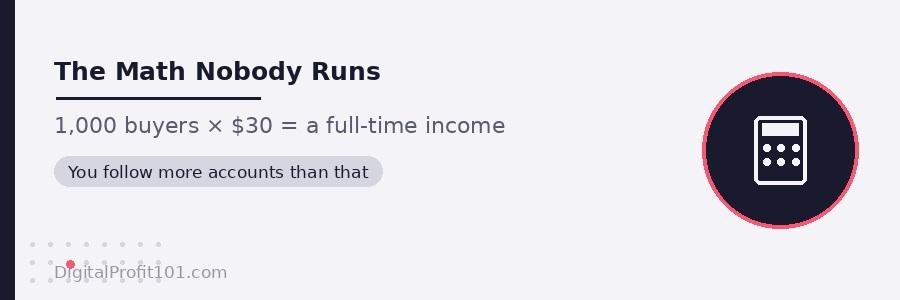
Now for the math that changes everything. You do not need 50,000 viewers. You need 1,000 people who think, “this person gets exactly my problem.”
Run the numbers. One thousand people who genuinely trust you, buying a single $30 product, is $30,000. Build a relationship where those same 1,000 people buy a few times a year, or buy a higher-priced offer, and you have a full-time income. From one thousand people.
1,000 true buyers × $30 product = $30,000
1,000 true buyers × $100/year = $100,000
One thousand. You probably follow more accounts than that right now. The number of people you need to build a sustainable creator income is smaller than your own following list.
This is the heart of what Kevin Kelly, the founding editor of Wired, called the “1,000 True Fans” theory back in 2008. His argument was simple and radical: a creator does not need millions of passive followers to make a living. They need a committed core of people who value their work enough to support it consistently. A true fan is someone who engages, tells their friends, and buys what you make. As Kelly framed it, even a one-in-a-million appeal can still find its thousand true fans.
💡 Why this is liberating: The viral model tells you success requires reaching everyone. The true buyers model tells you success requires deeply serving a specific someone. The second is not just kinder – it is dramatically more achievable, more sustainable, and more profitable for a small creator.
| Viral Reach | 1,000 True Buyers | |
| Audience size | 50,000+ strangers | 1,000 right people |
| Buyer intent | Almost none | High – they get it |
| Algorithm effect | Resets your targeting | Sharpens your targeting |
| Income at $30/product | Often $0 | Full-time income |
| Sustainability | Fleeting spike | Compounds over time |
| What they do | Like and leave | Screenshot and DM a friend |
The viral column looks impressive on a screenshot. The true buyers column pays your rent. Choose accordingly.
Applause from the wrong audience is worse than silence from the right one
Most creators optimize for the wrong signal. They chase the dopamine of broad approval – the big like count, the comment flood, the “everyone clapped” moment. But broad applause from people who will never buy is a vanity metric. It feels like progress while quietly leading you away from the people who actually matter to your business.
The shift is this: stop optimizing for “everyone clapped.” Start optimizing for “the right 100 people screenshot it and DM their friend.”
“Boring-to-most plus electric-to-few beats viral-to-all every time.”
When you write something that is electric to a few – so specific, so on-the-nose for one type of person that it makes them feel seen – they do not just like it. They save it. They screenshot it. They send it to a friend who has the exact same problem, with a message like “this is literally you.” That single share is worth more than ten thousand passive likes, because it reaches a new person through trust, with built-in context, from someone they already know.
Content that tries to please everyone gets a shrug from everyone. Content that is unapologetically for someone gets evangelized by that someone.

If you can’t name your reader in one sentence, that’s the real problem to solve
Here is the question that separates struggling creators from quietly profitable ones: who is the one specific person your content is secretly written for?
Not “entrepreneurs.” Not “people who want to make money online.” Not “creators.” Those are not people – they are vague categories that lead to vague content that resonates with no one. I mean a specific, nameable person with a specific, urgent problem.
If you cannot name that person in a single sentence, that is the actual problem. It is not your reach. It is not the algorithm. It is not how often you post. It is that your content is aimed at a crowd instead of a person, and crowds do not buy – people do.
🎯 The test: Before you publish anything, ask: “Will my one person feel like I read their mind?” If yes, publish. If it could apply to anyone, rewrite it until it could only apply to them. Specificity is not a limitation – it is the entire strategy.
The un-ignorable path: niche down, serve deeply, and show up consistently
Building a base of 1,000 true buyers is not glamorous, and it is not fast. But it is reliable, and it is entirely within your control. Here is the path the quietly profitable creators actually walk.
The instinct to appeal to everyone is the enemy. Pick a specific audience and a specific problem, and go narrower than feels comfortable. “Fitness” is a category. “Strength training for women over 40 with bad knees” is a business. The narrower your focus, the more unignorable you become to the people who match it.
Instead of producing shallow content for the masses, produce deep, genuinely useful content for your specific person. Solve their real problems completely. Answer the questions they are actually asking. Depth builds trust, and trust is what converts a follower into a buyer.
Show up regularly with content that consistently speaks to your one person. Consistency builds anticipation and trust over time. Your true buyers should come to rely on you as the person who understands their specific situation better than anyone else.
Social media platforms can change their algorithm overnight and cut your reach in half. An email list cannot. Move your true buyers off rented platforms and onto a channel you own – an email newsletter – where you can reach them directly, every time, without an algorithm deciding whether they see you.
True buyers need something to buy. A focused digital product – a PDF guide, a template pack, a mini-course, a coaching offer – priced at $30 or more, gives your relationship a destination. You do not need a huge catalogue. One excellent product that solves your one person’s urgent problem is enough to start.
The un-ignorable principle: The creators quietly making real money aren’t trending. They are un-ignorable to a specific person – and invisible to everyone else on purpose. That invisibility is not a failure. It is the strategy working exactly as intended.
For more on building a small, profitable audience and creating products they actually buy, explore the free guides Best Digital Products to Sell Online in 2026.

The whole philosophy, distilled – and where to go deeper
If you remember nothing else from this article, remember these five shifts:
1️⃣ Viral reach is a vanity metric. 50,000 strangers who’ll never buy are worth less than 1,000 people who get exactly what you do. Stop chasing reach for its own sake.
2️⃣ The math is smaller than you think. 1,000 true buyers at a $30 product is a full-time income. You follow more accounts than that right now. The number you need is achievable.
3️⃣ Specificity beats broad appeal Boring-to-most plus electric-to-few beats viral-to-all every time. Write for one person, not a crowd.
4️⃣ Name your one person If you can’t describe your ideal buyer in a single sentence, that’s the real problem to solve before anything else.
5️⃣ Be un-ignorable, not trending. The creators making real money are invisible to most people on purpose – and impossible to ignore for the right few.
The shift from “reach everyone” to “serve someone” is the single most profitable mindset change a small creator can make. It is the difference between a viral spike that fades and a true-buyer base that compounds into a real income.
Get the 1,000 True Buyers Math — In Full
Every week, the Digital Profit 101 newsletter unpacks the exact strategies behind building a small, profitable audience – the 1,000 true buyers who fund a full-time creator income. No fluff, no viral chasing, just the math that works.
👉 Read more and subscribe free: https://digitalprofit101.com
Not inherently – but for small creators trying to sell products, a viral hit often does more harm than good. It floods your audience with people who have no buying intent, which can confuse the algorithm about who your content is for and reduce the reach of your future, more targeted posts. Viral reach feels like success but rarely converts to income.
Introduced by Kevin Kelly in 2008, the theory holds that a creator does not need millions of followers to make a living – they need around 1,000 dedicated supporters who consistently buy what they create. At roughly $100 per fan per year, that is a $100,000 income. The modern version applies directly to digital product creators: 1,000 true buyers can sustain a full-time business.
Far fewer than most people assume. With a focused audience and a product priced at $30 or more, around 1,000 genuine buyers can generate a full-time income. What matters is not follower count but buyer intent – 1,000 engaged, well-matched people outperform 100,000 passive followers.
Describe your ideal buyer in a single sentence, including their specific situation and most urgent problem. Use their own words, not industry jargon. Then write every piece of content as if you are speaking directly to that one person. If your content could apply to anyone, it is too broad – narrow it until it could only apply to them.
Visit DigitalProfit101.com and subscribe to the Digital Profit 101 newsletter, where the 1,000 true buyers math and other audience-building strategies are unpacked in detail every week.
Ifeyinwa C. Ofulue is a writer, web developer, UX designer, digital product creator, and researcher focused on AI tools, automation, UX design, and online business systems. He is the author of The Power of Doing Nothing, How to Use Claude Code to Create Anything, and several other digital guides on online income, self-development, AI tools, and building profitable digital products. He helps beginners learn how to create digital products, build profitable websites, and use modern AI tools to generate income online. Find his work at digitalprofit101.com.
Through this website, I share practical tutorials, step-by-step guides, and proven strategies on topics such as AI productivity tools, website monetization, digital marketing, and automation.
My mission is simple: to make online business and digital skills accessible to anyone willing to learn.
When I’m not researching new web designs, AI tools, or writing tutorials, I focus on building scalable online systems and testing new ways to help creators earn online.
👉 Learn more about Ifeyinwa on the About page.