Physical Address
304 North Cardinal St.
Dorchester Center, MA 02124
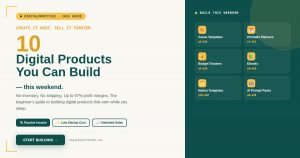
10 Digital Products You Can Create This Weekend (Create It Once. Sell It Forever.)These beginner-friendly digital products you can build in a weekend – and sell on autopilot for years
Imagine building something one weekend that keeps paying you for years.
Not a job. Not a client project you have to keep showing up for. A product – created once, sold an unlimited number of times, delivered automatically while you sleep, travel, or work on the next idea. That is the promise of digital products, and in 2026 it is more achievable for complete beginners than at any point in history.
I have spent years helping people build online income streams, and I can tell you this with confidence: digital products are the single best entry point into passive income for someone starting from scratch. No inventory. No shipping. No staff. No huge upfront investment. Just your knowledge, skills, or creativity, packaged into something people will gladly pay for.
The digital product opportunity is not hype – it is one of the fastest-growing markets on the planet.
$2.5 Trillion – The size of the global digital products industry in 2026
+70% – Growth in digital product transactions between 2022 and 2024
Up to 97% – Profit margin on digital products (no inventory, no shipping, no overhead)
Behind those numbers are real people – stay-at-home parents, students, freelancers, and side hustlers – quietly building income with products they created on a single weekend. By the end of this guide, you will know exactly which products to build, how to make them, what to charge, where to sell them, and how to get your first sale within seven days.
Let’s build something that pays you forever.
1. Why Digital Products Are So Profitable
2. The 10 Best Digital Products to Create This Weekend
3. Case Study: How a Beginner Earned Their First $1,000
4. Your 7-Day Digital Product Launch Plan
5. 10 Common Mistakes to Avoid
6. How to Make Even More Money (Monetization Strategies)
7. Frequently Asked Questions
The economics of digital products are unlike anything in the physical world
What makes digital products profitable? Digital products are profitable because they have no inventory or shipping costs, can be sold an unlimited number of times, deliver automatically, and carry profit margins of up to 97%. You create the product once and sell it repeatedly with almost no additional cost per sale.
To understand why digital products are so powerful, compare them to a traditional physical product business. A physical seller must buy stock, store it, package it, ship it, handle returns, and restock when inventory runs low. Every single sale costs them money in materials and logistics. Their growth is capped by how much stock they can afford and manage.
Digital products flip every one of those constraints.
No Inventory
Your product is a file. You never run out of stock, never tie up money in unsold inventory, and never worry about storage. Whether you sell one copy or ten thousand, you hold zero inventory.
No Shipping
The moment a customer pays, the product is delivered automatically – instantly, anywhere in the world. No packaging, no postage, no delays, no lost parcels.
Proceed to CheckoutUnlimited Sales Potential
A physical product can only be sold as many times as you have stock. A digital product can be sold an infinite number of times. The same eBook can be bought by 50,000 people without you doing anything extra after creating it once.
Sky-High Profit Margins
Because there is no cost per unit, nearly every dollar of revenue is profit. After the small transaction fee charged by your selling platform, you keep the vast majority of every sale. Few business models on earth offer margins this high.
Built-In Automation
The entire process – payment, delivery, receipts – can run on autopilot. This is what makes digital products a genuine passive income source: once it is set up, the system sells and delivers without your involvement.
💡 Pro Tip: The compounding advantage is real. Each digital product you create is an asset that keeps earning. Build one this weekend, another next month, and a third the month after, and within a year you have a portfolio of income-generating assets that work together – each one promoting the others.
Here are ten proven digital products, each genuinely achievable in a weekend by a beginner. For each one, you will find what it is, why it sells, who buys it, how to create it, the tools you need, what to charge, the profit potential, where to sell it, the difficulty level, and a pro tip from experience.
Canva templates are the easiest, fastest digital product for a complete beginner to create
Canva templates are pre-designed, editable graphics that buyers customise with their own text, colours, and images. Think Instagram post templates, Pinterest pins, presentation decks, business card designs, and social media kits.
Why It Sells
Every business owner, creator, and marketer needs professional graphics, but most lack the time or design skill to make them from scratch. A template gives them a polished result in minutes. Demand is enormous and evergreen.
Who Buys It
Small business owners, content creators, social media managers, coaches, bloggers, and solopreneurs.
How To Create It
Open Canva, design a set of 10–30 cohesive templates around a theme (for example, ‘Instagram templates for fitness coaches’), then create a shareable template link. Bundle them into a pack with a simple instruction guide.
| Tools Needed | Canva (free plan works) |
| Selling Price | $5 – $50 per pack |
| Profit Potential | $300 – $5,000+/month |
| Best Marketplaces | Etsy, Gumroad, Creative Market, your own site |
| Difficulty | ⭐ Beginner (easiest on this list) |
💡 Pro Tip: Niche down hard. ‘Instagram templates’ competes with thousands of sellers. ‘Instagram templates for vegan meal-prep coaches’ has almost no competition and a hungry, specific buyer. The narrower the niche, the easier the sale.
Printables are bought and re-bought by millions — a perennial best-seller on Etsy
Printable planners are downloadable PDF documents that buyers print at home or use digitally – daily planners, weekly schedules, meal planners, goal-setting sheets, and habit trackers.
Why It Sells
People love organisation tools, and printables deliver instant gratification at a low price. They are one of the most consistently purchased digital products on Etsy, year after year.
Who Buys It
Students, busy professionals, parents, productivity enthusiasts, and anyone trying to get organised.
How To Create It
Design your planner pages in Canva or Google Docs, keeping the layout clean and functional. Export as a print-ready PDF. Bundle several related pages into a complete planner set.
| Tools Needed | Canva or Google Docs |
| Selling Price | $7 – $25 per planner |
| Profit Potential | $200 – $4,000+/month |
| Best Marketplaces | Etsy (strongest), Gumroad, Payhip |
| Difficulty | ⭐ Beginner |
💡 Pro Tip: Etsy buyers actively search for printables. Use keyword-rich titles like ‘Minimalist Daily Planner Printable for Students’ so your product appears in search results – Etsy is essentially a search engine for digital downloads.
A budget tracker is a spreadsheet or fillable template that helps people manage their money – tracking income, expenses, savings goals, and debt payoff. They can be built in Excel, Google Sheets, or as a fillable PDF.
Why It Sells
Personal finance is a top-three evergreen niche. People will always want help managing money, and a well-built tracker that does the maths automatically feels like genuine value for a small price.
Who Buys It
Young professionals, families, freelancers with irregular income, and anyone working toward a financial goal.
How To Create It
Build the tracker in Google Sheets with automatic formulas (totals, category breakdowns, savings progress bars). Make it visually clean. Provide a simple guide on how to make a personal copy.
| Tools Needed | Google Sheets or Excel |
| Selling Price | $5 – $20 |
| Profit Potential | $200 – $3,000+/month |
| Best Marketplaces | Etsy, Gumroad, Payhip |
| Difficulty | ⭐⭐ Beginner–Intermediate |
💡 Pro Tip: Specificity wins again. A ‘Budget Tracker for Freelancers with Irregular Income’ will outsell a generic ‘Budget Spreadsheet’ because it speaks directly to a real, painful problem.
Ebooks package your knowledge; Notion templates package your systems — both sell beautifully
4. Ebooks
An ebook is a downloadable guide that teaches something or solves a problem. It is the classic digital product – and still one of the best, because knowledge is endlessly sellable.
Guides teaching non-technical people how to use AI for business and productivity are the fastest-growing ebook category in 2026, alongside niche personal finance and wellness workbooks. You do not need to write 200 pages – a focused 25-40 page guide that solves one specific problem sells best.
| What It Is | A downloadable PDF guide that teaches or solves a problem |
| Who Buys It | Anyone seeking to learn a skill or solve a specific problem |
| Tools Needed | Google Docs + Canva (or Claude AI to draft faster) |
| Selling Price | $9 – $30 |
| Profit Potential | $200 – $5,000+/month |
| Best Marketplaces | Selar, Gumroad, Amazon KDP, Payhip |
| Difficulty | ⭐⭐ Beginner–Intermediate |
5. Notion Templates
Notion templates are pre-built systems inside the popular Notion app — dashboards, project trackers, content calendars, CRMs, and life-planning systems. Notion has exploded in popularity, and its users love buying ready-made setups.
| What It Is | A pre-built system or dashboard inside Notion |
| Who Buys It | Productivity enthusiasts, students, freelancers, small teams |
| Tools Needed | Notion (free) |
| Selling Price | $10 – $40 |
| Profit Potential | $300 – $6,000+/month |
| Best Marketplaces | Gumroad, Notion’s template gallery, Etsy |
| Difficulty | ⭐⭐ Intermediate |
💡 Pro Tip: For both ebooks and Notion templates, use Claude AI to accelerate creation. It can outline your ebook and draft each chapter, or help you plan the structure of a complex Notion system in minutes.
Content packs and AI prompt libraries are two of the hottest digital products of 2026
6. Social Media Content Packs
A content pack is a bundle of done-for-you social media content – caption templates, content calendars, hashtag sets, hook formulas, and post ideas – that saves creators and businesses hours of work every week.
| What It Is | Done-for-you captions, calendars, and post ideas |
| Who Buys It | Small business owners, creators, social media managers |
| Tools Needed | Canva + Google Docs |
| Selling Price | $12 – $40 |
| Profit Potential | $300 – $4,000+/month |
| Best Marketplaces | Etsy, Gumroad, Selar |
| Difficulty | ⭐ Beginner |
7. AI Prompt Libraries
An AI prompt library is a curated collection of tested, ready-to-use prompts for tools like ChatGPT, Claude, and Midjourney. As millions adopt AI tools, demand for expertly crafted prompts has exploded – making this one of the breakout digital products of 2026.
| What It Is | A curated pack of tested AI prompts for a specific use case |
| Who Buys It | Marketers, creators, entrepreneurs, AI beginners |
| Tools Needed | ChatGPT or Claude + Google Docs |
| Selling Price | $8 – $30 |
| Profit Potential | $200 – $3,000+/month |
| Best Marketplaces | Gumroad, Etsy, Selar, PromptBase |
| Difficulty | ⭐ Beginner |
💡 Pro Tip: If you already use AI tools daily, the prompts you have refined are a product waiting to be packaged. Organise your best prompts by category, add usage instructions, and you have a sellable library within a day.
Workbooks, website templates, and mini-courses are higher-value products that command premium prices
8. Digital Workbooks
A digital workbook is an interactive, fillable document that guides the buyer through a process – a business-planning workbook, a self-care journal, a goal-setting workbook, or a course companion. Workbooks command higher prices than simple printables because they deliver a guided transformation.
| What It Is | An interactive, fillable guided document |
| Who Buys It | Coaches’ clients, students, self-improvement seekers |
| Tools Needed | Canva (with fillable PDF fields) |
| Selling Price | $9 – $24 |
| Profit Potential | $300 – $4,000+/month |
| Best Marketplaces | Etsy, Gumroad, Selar |
| Difficulty | ⭐⭐ Beginner–Intermediate |
9. Website Templates
Website templates are pre-designed, ready-to-customise site layouts for platforms like WordPress, Wix, Squarespace, Webflow, or Shopify. Buyers get a professional website foundation without paying a developer. These command premium prices and serve a steady, high-intent market.
| What It Is | A ready-to-customise website layout or theme |
| Who Buys It | Small businesses, freelancers, bloggers, agencies |
| Tools Needed | Website builder (Wix, WordPress, Webflow, etc.) |
| Selling Price | $25 – $150+ |
| Profit Potential | $500 – $8,000+/month |
| Best Marketplaces | Creative Market, ThemeForest, Gumroad |
| Difficulty | ⭐⭐⭐ Intermediate |
10. Online Mini-Courses
A mini-course is a short, focused video or text course that teaches one specific skill or delivers one clear outcome. Courses have the highest revenue-per-sale of any digital product, and a tightly focused mini-course is realistic to outline and record in a weekend (with light editing afterward).
| What It Is | A short, focused course delivering one clear outcome |
| Who Buys It | Anyone wanting to learn a specific skill quickly |
| Tools Needed | Smartphone/screen recorder + Selar or Teachable |
| Selling Price | $20 – $200 |
| Profit Potential | $1,000 – $20,000+/month |
| Best Marketplaces | Selar, Teachable, Thinkific, Gumroad |
| Difficulty | ⭐⭐⭐ Intermediate |
💡 Pro Tip: Start small with your first course. A focused 5-7 lesson mini-course that delivers one specific result will sell better — and be far easier to create – than a sprawling 50-lesson program. You can always build the bigger course later.
Let me show you how these pieces fit together in the real world. Here is a realistic, repeatable example of how a complete beginner could earn their first $1,000 selling digital products.
Amara had no audience, no website, and no design experience. What she did have was a knack for organising her family’s finances and 30 minutes a day during her child’s nap time. Here is exactly what she did.
The Product Created
Amara built a ‘Family Budget Tracker for Single-Income Households’ in Google Sheets – a clean spreadsheet with automatic calculations, a savings-goal tracker, and a simple monthly overview. She priced it at $15.
Time Spent
She spent one weekend building the tracker (about 8 hours total), then 30 minutes a day promoting it over the following weeks.
Marketing Method
Amara joined three Facebook groups for budgeting and frugal-living families. She did not spam them – she shared genuinely helpful tips about saving money, and when people asked how she tracked everything, she mentioned her tracker. She also posted a simple ‘before and after’ of her own budget on Instagram and pinned her product to Pinterest with keyword-rich descriptions.
Revenue Generated
Sales started slow – three in the first week. But the Pinterest pins began driving steady traffic, and word spread in the Facebook groups. By the end of month two, she had sold 68 copies.
68 sales × $15 = $1,020 – her first four-figure milestone, from one weekend’s work
The most important part? That tracker keeps selling. Amara has since added two more products – a debt-payoff planner and a meal-planning printable – and her three products now cross-promote each other. Her one weekend of work became the foundation of a growing digital product business.
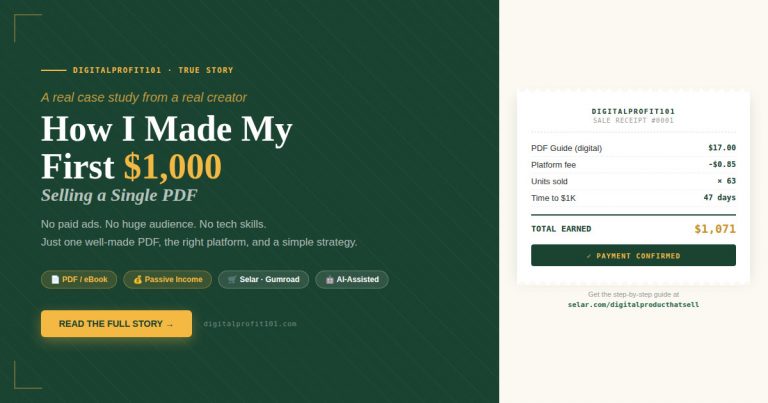
Want a deeper breakdown of how to hit your first $1,000? Read our full guide: “How I Made My First $1,000 Selling a PDF“ on DigitalProfit101.com.
A simple day-by-day plan takes you from idea to first sale in one week
How fast can you launch a digital product? You can launch a digital product in as little as 7 days. Spend days 1-2 choosing your idea and validating demand, days 3-4 creating the product, day 5 setting up your store, day 6 preparing your launch content, and day 7 going live and promoting to your audience.
Pick one product type from this guide that matches your skills and interests. Then niche it down to a specific audience. Do not overthink this – your first product is a starting point, not your magnum opus.
Spend an hour confirming people want it. Search Etsy, Gumroad, and Google to see if similar products sell. Check whether people ask about your topic in relevant Facebook groups or on Reddit. If others are selling it, that is proof of demand – not a reason to quit.
Build the main product. Use Canva, Google Docs, Sheets, or Notion depending on your product type. Use Claude AI to speed up writing and structuring. Focus on finishing, not perfecting.
Refine your product, create a professional cover or mockup in Canva, and write a clear, benefit-focused product description. Add a simple instruction guide so buyers know exactly how to use what they bought.
Create a free account on Selar, Gumroad, Payhip, or Etsy. Upload your product, set your price, add your cover image, and publish. Your store can be live in under an hour.
Create the content you will use to promote: a few social media posts, a Pinterest pin or two, and a short announcement message for WhatsApp and any groups you are part of. Line it all up so launch day is smooth.
Go live. Announce your product everywhere you have a presence – WhatsApp status, Instagram, relevant Facebook groups, Pinterest. Message people you know who might want it. Your first sale is closer than you think – and it changes everything.
💡 Pro Tip: Do not wait for ‘ready.’ Set the 7-day deadline and hit it. A finished product earning $15 a sale beats a ‘perfect’ product that never launches. Momentum is the most valuable asset a beginner can build.
After helping many beginners launch, I see the same avoidable mistakes again and again. Here is how to sidestep them.
Once your first product is selling, these strategies multiply your revenue from the same audience and effort.
Recommend tools you genuinely use (Canva, Notion, your selling platform) through affiliate links in your product, emails, and content. You earn a commission on every sign-up – extra income on top of your product sales, at no cost to your buyer.
Offer a complementary product at checkout. Someone buying your budget tracker might add a debt-payoff planner for a small extra amount. Upsells can increase your average order value by 30% or more with zero additional traffic.
Package several related products together at a discounted combined price. Bundles increase perceived value and average order value simultaneously – buyers feel they are getting a deal while you earn more per transaction.
Turn one-time buyers into recurring revenue with a monthly membership – a content library, a community, or fresh templates each month. Recurring income is the most stable and valuable revenue a digital creator can build.
Your digital product establishes you as an expert. Some buyers will want personalised help – offer coaching or done-for-you services at a premium price. Products build trust and audience; services capture high-value buyers.
💡 Pro Tip: The smartest creators stack these. A buyer discovers you through a $15 product, joins your email list, buys a $40 bundle, subscribes to a $10/month membership, and eventually books a $200 coaching session. One small product becomes the doorway to a full business.
Here is the truth that separates the people who build digital income from the people who only read about it: the ones who succeed simply start. They pick one product, give themselves a weekend, and build it – imperfectly, nervously, but completely.
You now have everything you need. Ten proven products. The tools to make them. The prices to charge. The platforms to sell on. A 7-day plan to launch. The mistakes to avoid. And the strategies to grow. The only ingredient left is your decision to begin.
So here is my challenge to you: choose one product from this guide – just one – and commit to building it this weekend. Not next month. Not ‘someday.’ This weekend. Create it once, and let it sell forever.
Your future self – the one earning passive income from a product you haven’t built yet – is waiting for you to start.
🚀 Start Your Digital Product Journey Today
DigitalProfit101 is your home base for building real online income. Get free, beginner-friendly guides on digital products, passive income, and online business – plus exclusive resources delivered to your inbox.
👉 Explore free guides & subscribe: https://digitalprofit101.com/home
Canva templates and printable planners are the easiest digital products for beginners. Both require no technical skills, can be made in a few hours using free tools, and have strong, evergreen demand on marketplaces like Etsy and Gumroad.
Earnings vary by product and effort. Realistically, a single ebook or template can earn $100-$2,000 per month passively, a template bundle can earn $500-$5,000 per month, and a course can earn $2,000–$20,000+ per month. Income compounds as you add more products.
No. Marketplaces like Selar, Gumroad, Payhip, and Etsy host your product, handle checkout, and deliver files automatically – no website required. A website becomes useful later, once you have an audience to drive to it directly.
Online courses and memberships have the highest revenue per sale and profit margins (85-95%), while ebooks and templates offer the best effort-to-income ratio for beginners. The most profitable product is the one that solves a specific, urgent problem for a defined audience.
Start with a simple product like a Canva template, a printable planner, or a short ebook. Use free tools (Canva, Google Docs, Google Sheets) and AI assistants like Claude to speed up creation. Choose a topic you already understand, and finish a focused first version in a weekend.
For African and global creators, Selar is excellent (it supports local payments). Etsy is best for printables and templates due to built-in search traffic. Gumroad and Payhip are great all-rounders with low fees. Many sellers list on multiple platforms simultaneously.
Yes – more than ever. The digital products industry is worth $2.5 trillion in 2026, with transactions up 70% in recent years. Demand for practical, problem-solving digital products continues to grow as more people shop and learn online.
Simple products like templates, planners, and AI prompt packs can be created in a few hours to a weekend. Ebooks take one to three days, especially with AI assistance. Courses take longer, but a focused mini-course can be outlined and recorded in a weekend with editing afterwards.
Absolutely. Digital products are ideal for side hustlers because they sell and deliver automatically. You can create a product on a weekend and promote it for 30 minutes a day, with sales arriving around the clock without your active involvement.
No. Tools like Canva provide professional templates that make anyone capable of producing polished products. For text-based products like ebooks and AI prompt packs, no design skill is needed at all – just clear, useful content.
Ifeyinwa C. Ofulue is a writer, web developer, UX designer, digital product creator, and researcher focused on AI tools, automation, UX design, and online business systems. He is the author of The Power of Doing Nothing, How to Use Claude Code to Create Anything, and several other digital guides on online income, self-development, AI tools, and building profitable digital products. He helps beginners learn how to create digital products, build profitable websites, and use modern AI tools to generate income online. Find his work at digitalprofit101.com.
Through this website, I share practical tutorials, step-by-step guides, and proven strategies on topics such as AI productivity tools, website monetization, digital marketing, and automation.
My mission is simple: to make online business and digital skills accessible to anyone willing to learn.
When I’m not researching new web designs, AI tools, or writing tutorials, I focus on building scalable online systems and testing new ways to help creators earn online.
👉 Learn more about Ifeyinwa on the About page.