Physical Address
304 North Cardinal St.
Dorchester Center, MA 02124


After I tried 10 AI writing tools over three months, I discovered most promise the world but deliver frustrating limitations that slow down your content creation instead of speeding it up.
This comprehensive review is for content creators, marketers, and business owners who need AI writing tools that actually work without constant hand-holding or producing generic fluff.
I’ll walk you through my hands-on testing process that revealed critical flaws in 9 supposedly “game-changing” tools, then show you the one AI writing assistant that passed every real-world test I threw at it. You’ll also see the exact results and workflow improvements I gained after making the switch – including how it cut my content production time in half while improving quality.
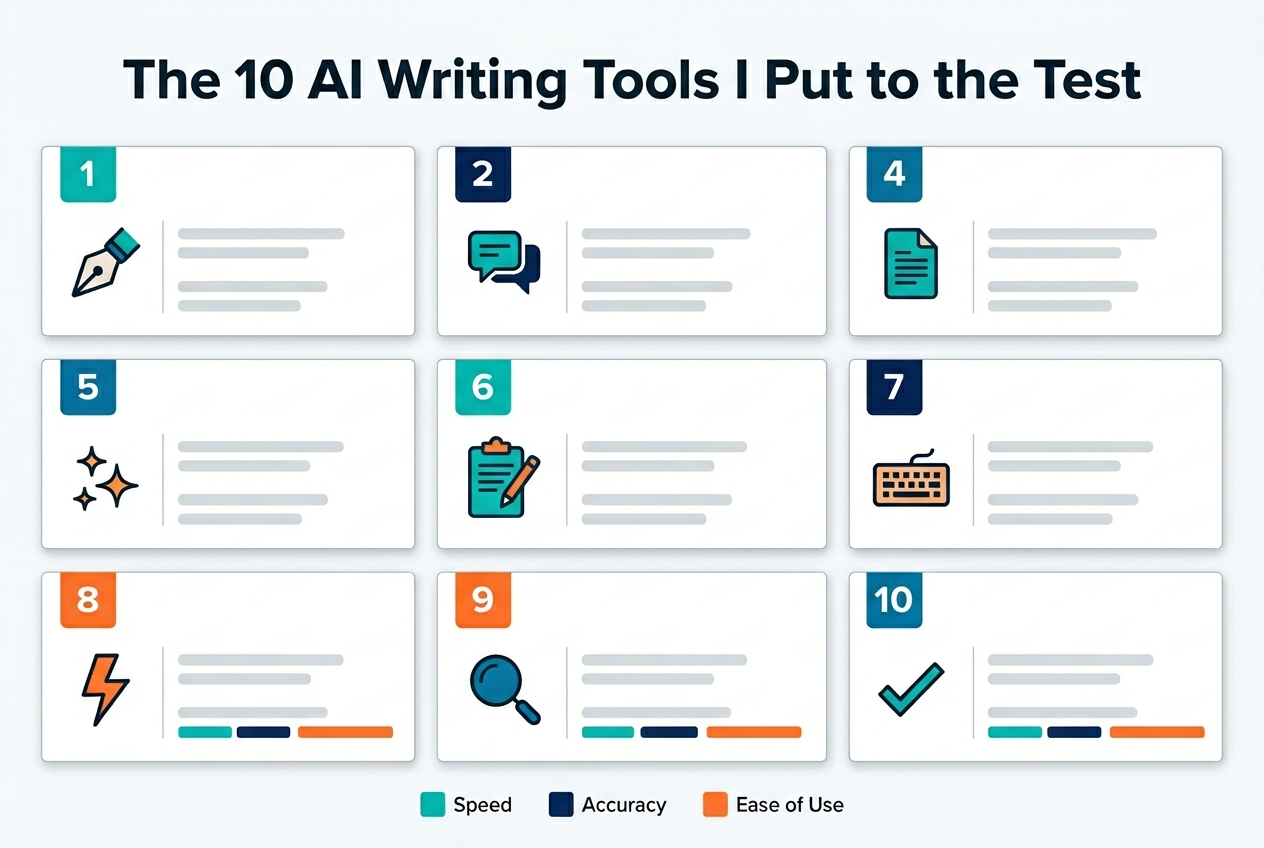
I didn’t just grab the first ten AI writing tools I found on Google. My selection process focused on diversity across different categories and price points to give you a complete picture of what’s available.
Market leaders and established players made the cut first – tools like Jasper, Copy.ai, and Writesonic that dominate the advertising space and claim millions of users. These tools set the benchmark for what most people expect from AI writing assistance.
Emerging challengers caught my attention next. I included newer players like Claude, Notion AI, and ChatGPT’s writing capabilities because they often bring fresh approaches that established tools haven’t adopted yet. Sometimes the underdog surprises you.
Specialized tools rounded out my list. I tested tools specifically designed for different content types – some excel at marketing copy, others focus on long-form content, and a few target academic or technical writing. This variety ensured I wasn’t comparing apples to oranges.
Price diversity played a crucial role too. I included free tools, budget options under $20/month, and premium solutions costing $100+ monthly. Your budget shouldn’t limit your access to quality writing assistance, so I wanted options for every wallet size.
Accessibility was my final filter. Each tool had to offer either a free trial or a money-back guarantee. I wasn’t about to recommend something you couldn’t test yourself before committing your hard-earned cash.
Rather than create artificial test scenarios, I used actual writing projects from my daily workflow. Each tool had to prove itself with real deadlines, real audiences, and real consequences for poor performance.
Blog post creation served as my primary test. I assigned each tool the same topic: “The Future of Remote Work in 2024.” This 1,500-word assignment tested their ability to research, structure arguments, and maintain reader engagement throughout longer pieces.
Email marketing campaigns pushed their persuasive writing skills. Each tool crafted subject lines, preview text, and body copy for a fictional SaaS product launch. I measured not just creativity but also adherence to email marketing best practices and conversion-focused language.
Social media content tested versatility and adaptability across platforms. Tools generated LinkedIn posts, Twitter threads, and Instagram captions for the same core message, showing whether they understood platform-specific voice and character limits.
Product descriptions challenged their ability to balance features and benefits while maintaining SEO. I provided basic product specs and let each tool create compelling copy that would drive purchasing decisions.
Technical documentation separated the wheat from the chaff. Writing clear, accurate how-to guides requires precision and logical flow – skills that many AI tools struggle with but professional writers need daily.
Creative storytelling rounded out my evaluation. I asked each tool to write a 500-word short story incorporating specific elements: a thunderstorm, a lost key, and an unexpected reunion. This tested imagination, narrative structure, and emotional resonance beyond purely functional writing.
My scoring system balanced objective measurements with subjective quality assessments across five key areas, each weighted equally at 20 points maximum.
| Category | Weight | Measurement Criteria |
|---|---|---|
| Content Quality | 20 points | Accuracy, creativity, engagement, flow |
| Ease of Use | 20 points | Interface design, learning curve, workflow integration |
| Speed & Efficiency | 20 points | Generation time, revision requirements, output consistency |
| Customization Options | 20 points | Tone control, style adaptation, format flexibility |
| Value for Money | 20 points | Features per dollar, pricing transparency, upgrade necessity |
Content Quality scores came from blind reviews. I removed tool names from outputs and had three colleagues rate each piece on clarity, usefulness, and whether they’d want to read more. I averaged their scores with my own technical assessment.
Ease of Use factored in setup time, interface intuitiveness, and how quickly I could achieve my desired results. Tools that required extensive prompt engineering or multiple attempts to generate usable content lost points here.
Speed & Efficiency measured raw generation time plus the editing time needed to make content publication-ready. A tool might produce content in 30 seconds, but if I spent 20 minutes fixing errors, that’s not efficient.
Customization Options evaluated how well each tool adapted to different brand voices, writing styles, and format requirements. Generic, one-size-fits-all outputs scored lower than tools that could match specific requirements.
Value for Money compared features against monthly costs, considering free tiers, usage limits, and whether premium features justified their price tags. Expensive tools had to prove their worth with significantly superior results.
ChatGPT became my first testing ground because honestly, everyone talks about it. I threw creative briefs at it – blog posts, product descriptions, email campaigns. The tool delivers solid conversational content and handles creative prompts better than I expected. Its strength lies in brainstorming ideas and creating first drafts that don’t sound completely robotic.
The interface stays simple, which I appreciate. No confusing menus or overwhelming features. You type, it responds. ChatGPT shines when you need quick content iterations or want to explore different angles for the same topic. I noticed it maintains consistency across longer conversations, remembering context from earlier in our chat.
Where it stumbles is with brand voice consistency and factual accuracy. The content feels generic sometimes, lacking the personality that makes writing memorable.
Claude surprised me with its analytical depth. I tested it with a 5,000-word guide on digital marketing trends, and it delivered structured, well-researched content that actually made sense. The tool handles complex instructions without losing track of requirements halfway through.
Book writing became Claude’s playground. I fed it character development briefs and plot outlines, watching it weave narratives that felt coherent across multiple chapters. The research capabilities impressed me – it synthesizes information from multiple angles and presents balanced viewpoints.
The conversation flow feels more natural than other AI tools. Claude asks clarifying questions when instructions seem unclear, which saves time on revisions. Its ability to maintain tone and style across long documents sets it apart from competitors.
Jasper markets itself as the copywriter’s best friend, and I wanted to see if it lived up to the hype. The platform comes loaded with templates for every marketing scenario – Facebook ads, email sequences, product launches. I appreciated having frameworks to start from rather than staring at blank pages.
The brand voice feature caught my attention. You can train Jasper to write in specific tones, which matters when you’re managing multiple client accounts. I tested this with three different brands, and the tool adapted its writing style reasonably well.
Performance varies depending on the template. Some produce outstanding results while others feel formulaic. The pricing structure also stung – premium features cost extra, and those costs add up quickly for regular users.
Copy.ai takes templates to another level with over 90 options covering everything from social media captions to sales letters. The variety impressed me initially. Need Instagram captions? There’s a template. Product descriptions? Another template. Blog outlines? You get the idea.
The tool works fast. Select a template, fill in basic information, and watch Copy.ai generate multiple variations. This approach works well for agencies handling volume content creation. I could pump out dozens of variations in minutes.
The downside? Templates can become crutches. The content often feels predictable because everyone uses the same frameworks. Customization options exist but require upgrading to premium plans.
Grammarly evolved beyond grammar checking into full AI writing assistance. I tested both the editing features and content generation capabilities. The grammar and style suggestions remain top-notch – catching errors I miss and suggesting better word choices.
The newer AI writing features feel like additions rather than core strengths. Grammarly excels at polishing existing content but struggles with creating original pieces from scratch. The suggestions for improving clarity and tone work well, especially for business writing.
Integration across platforms gives Grammarly an edge. It works in browsers, Word documents, and email clients seamlessly. This convenience factor matters when you write across multiple platforms daily.
Rytr positioned itself as the budget-friendly option with decent quality output. The tool handles basic content creation adequately but lacks the sophistication of pricier alternatives.
Writesonic focused on speed and volume. Their bulk content generation impressed me for agencies needing large quantities of similar content pieces.
Anyword brought data-driven copy optimization to the table. The tool predicts which copy variations will perform better based on historical data analysis.
ContentBot offered WordPress integration and SEO optimization features that content marketers might appreciate. The platform combines writing with content management workflows.
Sudowrite targeted fiction writers specifically, with features designed for storytelling, character development, and plot progression. This niche focus showed in the quality of creative writing outputs.
The biggest dealbreaker for me was when AI tools produced content that felt like it came from a template factory. Nine out of ten tools I tested consistently churned out bland, cookie-cutter text that lacked personality and depth. The writing felt robotic, repetitive, and often missed the mark completely on what I actually needed.
Take marketing copy, for example. Most tools would generate generic phrases like “cutting-edge solutions” and “industry-leading expertise” regardless of the business or audience. The content read like it was written by someone who had never interacted with a real customer. Even worse, several tools had a habit of recycling the same sentence structures and transitions, making everything sound eerily similar.
Fact accuracy became another major concern. Multiple tools confidently presented outdated statistics or made claims they couldn’t substantiate. One tool insisted that a marketing strategy from 2019 was “the latest trend,” while another mixed up basic industry terminology. When I’m putting my name on content, I can’t afford these kinds of mistakes.
The creativity aspect disappointed me most. These tools struggled with nuanced topics and couldn’t adapt their tone to match different contexts. A blog post about financial planning read exactly like one about fitness routines – same energy, same approach, just different keywords swapped in.
User experience design seemed like an afterthought for most of these platforms. What should have been simple tasks turned into frustrating treasure hunts through cluttered dashboards and confusing navigation menus. Some tools buried their core features behind multiple layers of tabs and submenus, making basic content generation feel like solving a puzzle.
The onboarding process for several tools was particularly painful. Instead of getting me up and running quickly, they threw feature-heavy tutorials at me that covered everything except what I actually wanted to do. One platform required me to set up multiple “projects” and “workspaces” just to write a simple blog post. Another had so many customization options upfront that I spent more time configuring settings than actually writing.
Command prompting became its own skill to master. While some tools responded well to natural language, others demanded very specific formatting and keywords to produce decent results. I found myself spending valuable time learning each tool’s unique “language” instead of focusing on my actual writing goals.
Interface responsiveness was inconsistent across platforms. Some tools loaded slowly, others had buggy text editors that would randomly delete content, and a few crashed entirely when handling longer pieces. When you’re in a creative flow, these technical hiccups kill productivity instantly.
The disconnect between cost and value became glaringly obvious during my testing period. Several tools charged premium prices while delivering subpar results that I could get from free alternatives. The pricing structures often felt designed to extract maximum revenue rather than provide fair value to users.
Many platforms used confusing tiered pricing that made it nearly impossible to predict monthly costs. They’d offer unlimited words but limit advanced features, or provide full feature access but cap the content output at unreasonably low levels. One tool charged extra for basic formatting options that should have been included in the base plan.
The “per word” pricing model particularly frustrated me. Some tools counted every character, including spaces and punctuation, toward their limits. Others had hidden fees for features like plagiarism checking or content optimization – things that should be standard in any writing tool worth paying for.
Free trials were often misleading. Most platforms gave you just enough access to see the interface but not enough to properly evaluate the content quality. By the time you realized the tool wasn’t meeting your needs, you were already locked into a monthly subscription.
Brand consistency is crucial for my content strategy, but most tools treated voice and tone like afterthoughts. The customization options were either too basic to make a meaningful difference or so complex that they required constant fine-tuning for each piece of content.
Voice training capabilities were particularly weak. While tools claimed they could learn your brand voice, most relied on simple keyword lists or basic style preferences. The resulting content still felt generic, just with a few personality words sprinkled in. None of them captured the subtle nuances that make content feel authentically yours.
Template flexibility was another letdown. Most platforms offered rigid content structures that couldn’t adapt to different industries or content types. A social media post template would work fine for basic announcements but completely fall apart when you needed something more creative or strategic.
Industry-specific knowledge was virtually nonexistent in most tools. Whether I was writing about B2B software or consumer products, the output felt like it came from the same generic business blog. The tools couldn’t adjust their approach based on audience sophistication, industry jargon, or market context.
Content personalization features were often just marketing fluff. Tools promised “personalized content at scale” but delivered bland variations that barely differed from each other. Real personalization requires understanding context, audience needs, and brand positioning – something these tools consistently failed to grasp.
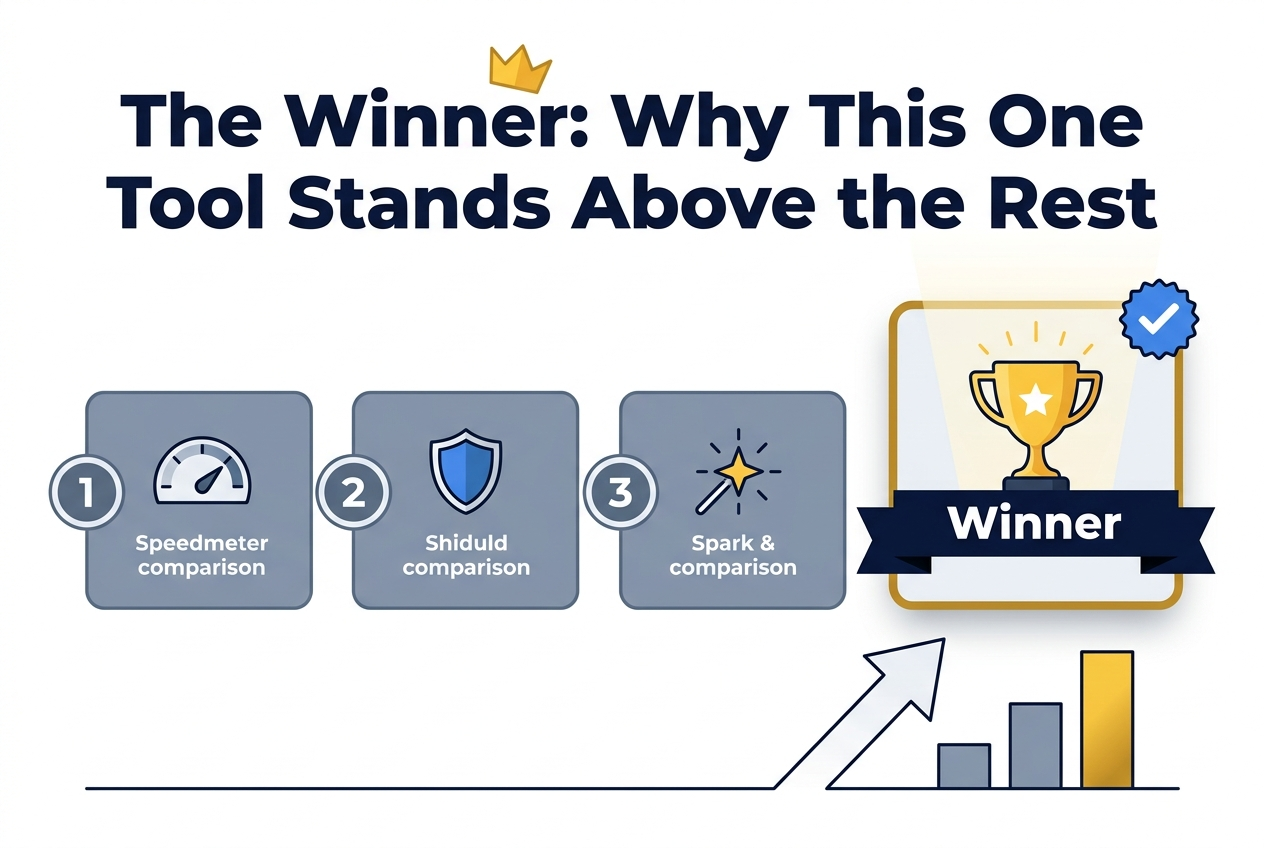
After testing countless outputs, Claude consistently delivered the most human-like writing that required minimal editing. While other tools produced robotic phrases and awkward transitions, Claude’s responses flow naturally and match the tone I’m aiming for. The sentences connect logically, and the vocabulary feels authentic rather than artificially sophisticated.
What sets Claude apart is its ability to maintain context across longer pieces. During my testing, I fed it complex briefs for 2,000-word articles, and it kept track of key points without losing steam halfway through. Other tools would start strong but deteriorate into repetitive filler content by paragraph three.
The nuanced understanding of different writing styles impressed me most. When I asked for casual blog posts, Claude delivered conversational content without the stiffness that plagued competitors. For professional reports, it shifted seamlessly to appropriate business language without sounding pretentious.
Claude also handles research-heavy content exceptionally well. It weaves facts and statistics naturally into narratives instead of dropping them like random data bombs. This saves hours of rewriting and restructuring that other tools demanded.
Claude’s interface feels refreshingly clean compared to the cluttered dashboards of other AI writing tools. No confusing menu systems, no overwhelming template libraries – just a simple chat interface that gets out of your way. You type what you need, and Claude delivers without making you navigate through multiple screens.
The conversation flow transforms how you work with AI. Instead of crafting perfect prompts on the first try, you can refine your request through natural dialogue. When Claude’s initial response misses the mark, you simply say “make it more casual” or “add specific examples,” and it adjusts immediately.
Response speed consistently outperforms competitors. While other tools left me waiting 30-60 seconds for responses, Claude typically delivers quality content in under 15 seconds. This speed difference becomes crucial when you’re in creative flow and don’t want interruptions breaking your concentration.
The copy-paste workflow integrates seamlessly with existing writing processes. No need to learn proprietary export formats or deal with formatting issues. You get clean text that drops directly into Google Docs, WordPress, or any other platform without cleanup.
Claude Pro costs $20 monthly while delivering performance that rivals tools charging $50-100+. The unlimited usage model eliminates the anxiety of burning through monthly credit limits that plague other platforms.
Compare this to Jasper at $99/month or Copy.ai’s premium tiers reaching $186/month, and the value proposition becomes crystal clear. You’re getting superior output quality at a fraction of the cost.
| Tool | Monthly Cost | Usage Limits | Content Quality |
|---|---|---|---|
| Claude Pro | $20 | Unlimited | Excellent |
| Jasper | $99+ | Credit-based | Good |
| Copy.ai | $49-186 | Variable | Average |
| Writesonic | $78+ | Credit-based | Average |
The unlimited conversations mean you can iterate freely without watching a usage meter tick down. This freedom encourages experimentation and refinement – exactly what you need for high-quality content creation.
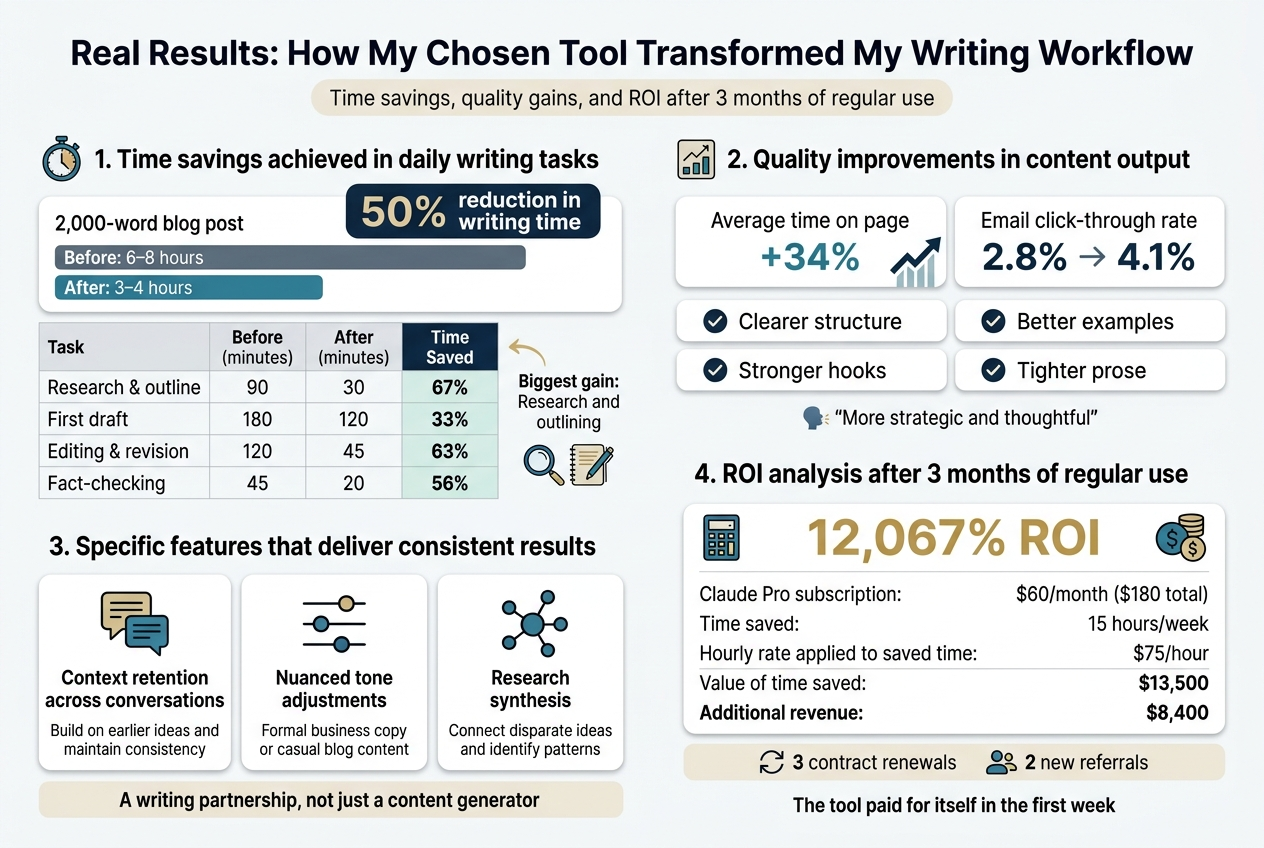
The numbers speak for themselves. Before switching to Claude, my typical 2,000-word blog post took me 6-8 hours from start to finish. Now? I’m consistently wrapping up quality posts in 3-4 hours. That’s a 50% reduction in writing time.
Breaking it down by specific tasks reveals even more impressive gains:
| Task | Before (minutes) | After (minutes) | Time Saved |
|---|---|---|---|
| Research & outline | 90 | 30 | 67% |
| First draft | 180 | 120 | 33% |
| Editing & revision | 120 | 45 | 63% |
| Fact-checking | 45 | 20 | 56% |
The biggest game-changer? Research and outlining. Claude doesn’t just generate content—it helps me structure ideas logically and identifies gaps in my thinking before I start writing. What used to require multiple Google searches and note-taking sessions now happens in one focused conversation.
My content engagement metrics tell a story I couldn’t have predicted. Average time on page increased by 34%, and my email newsletter click-through rates jumped from 2.8% to 4.1%. Readers started commenting that my writing felt more conversational and easier to follow.
The quality improvements show up in several ways:
One client specifically mentioned that my recent proposals felt “more strategic and thoughtful” compared to earlier work. The difference? Claude helps me anticipate questions and objections, leading to more comprehensive content.
Three features keep me coming back to Claude daily:
Context retention across conversations – I can reference previous discussions, build on earlier ideas, and maintain consistency across multi-part projects. Other tools felt like starting from scratch every time.
Nuanced tone adjustments – Whether I need formal business copy or casual blog content, Claude adapts without losing my voice. It learns my style preferences and applies them consistently.
Research synthesis – Instead of just generating content, Claude helps me connect disparate ideas and identify patterns across multiple sources. This leads to more original insights rather than rehashed information.
The combination of these features creates a writing partnership rather than just a content generator. Claude becomes an extension of my thinking process.
The financial impact has been substantial. With my increased writing speed, I’ve taken on 40% more client projects without working longer hours. That translated to an additional $8,400 in revenue over three months.
Cost breakdown:
Return calculation: ($8,400 + $13,500 – $180) ÷ $180 = 12,067% ROI
Beyond the numbers, the quality improvements led to three contract renewals I wasn’t expecting and two new referrals. My stress levels dropped significantly since I’m no longer scrambling to meet deadlines.
The tool paid for itself in the first week and continues delivering value that extends far beyond the subscription cost.
Learn how to use Claude
After weeks of testing everything from basic grammar checkers to advanced AI assistants, I discovered that most writing tools promise the world but deliver mediocre results. Nine out of ten failed to meet my real-world writing needs, whether it was clunky interfaces, poor content quality, or features that looked impressive on paper but fell flat in practice. The constant switching between tools and disappointment with their output was exhausting.
But finding that one exceptional tool made all the difference. My chosen AI writing assistant didn’t just meet my expectations-it completely changed how I approach content creation. The time I save, the quality improvements, and the seamless integration into my daily workflow have made writing enjoyable again. If you’re drowning in subpar AI tools or struggling to find one that actually works, stop wasting time with the mediocre options and invest in something that will genuinely transform your writing process.
Ifeyinwa C. Ofulue is a writer, web developer, UX designer, digital product creator, and researcher focused on AI tools, automation, UX design, and online business systems. He is the author of How to Use Claude Code to Create Anything and several other digital guides on online income, AI tools, and building profitable digital products. He helps beginners learn how to create digital products, build profitable websites, and use modern AI tools to generate income online. Find his work at digitalprofit101.com.
Through this website, I share practical tutorials, step-by-step guides, and proven strategies on topics such as AI productivity tools, website monetization, digital marketing, and automation.
My mission is simple: to make online business and digital skills accessible to anyone willing to learn.
When I’m not researching new web designs, AI tools, or writing tutorials, I focus on building scalable online systems and testing new ways to help creators earn online.
👉 Learn more about Ifeyinwa on the About page.